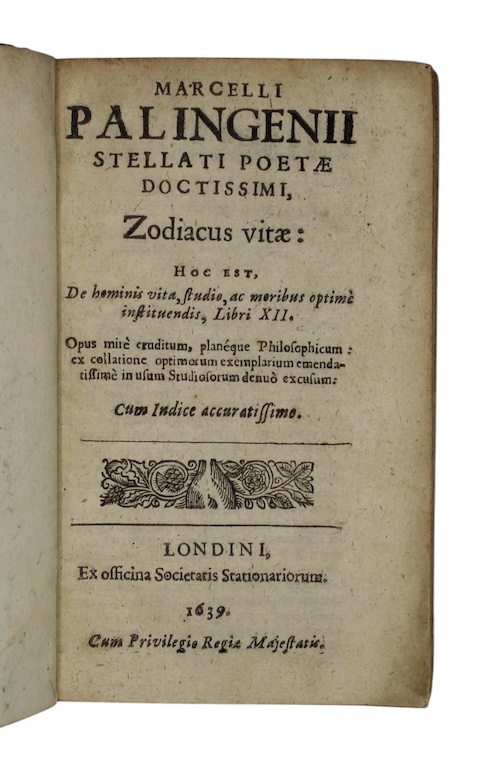
Marcelli palingenii stellati poetæ doctissimi Zodiacus vitæ...
Londini [i.e. London].
Ex officina Societatis Stationariorum, 1639.
8vo.
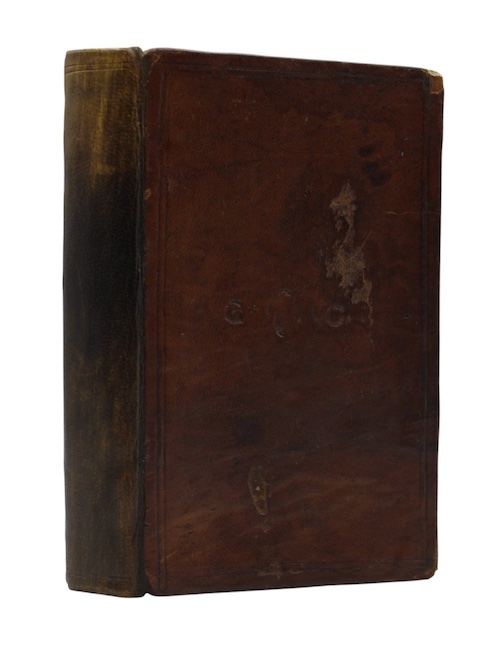
294pp, [66]. Contemporary blind-ruled calf, blind-stamped initials 'G. C. ' to boards, recently rebacked. Boards rubbed and marked. Pastedowns sprung, contemporary ownership inscriptions and annotations of Giles Combe to fly-leaves, marginal loss to leaves Q2 and S2.
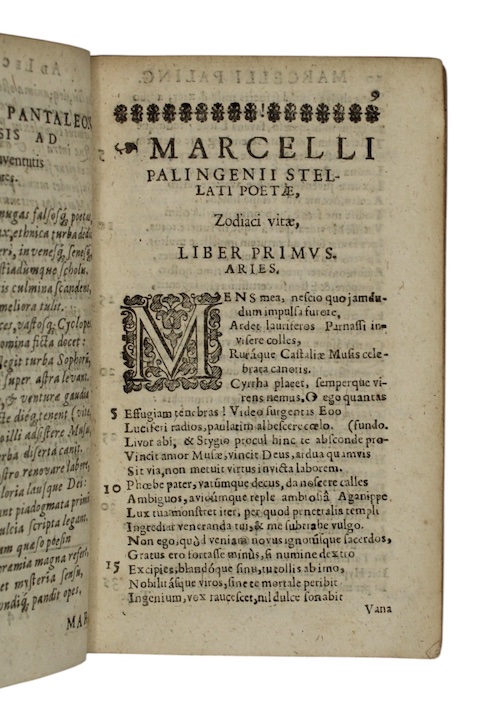
An early seventeenth-century edition of an astrological verse first printed in Venice in approximately 1536. The initial letters of the opening 29 lines of the first part 'Aires' form the acrostic of 'Marcellus Palingenius Stellatus', commonly thought to be the anagrammatic pseudonym of Pier Angelo Manzolli, of Stellata in Ferrar.
The erudite didactic poem advocates the pursuit tangible knowledge (comparable to Platonic ideals) as being the path to the contentment of humanity, and vehemently satirises ecclesiastical hypocrisy - particularly in regard to the Papacy. The text proved a sensation throughout Europe, with a plethora of editions and translations being made - including a 1565 printing in English by Barnabe Googe. The reception in Italy however was far from laudatory - the Inquisition deemed the work heretical; upon the authors death his mortal remains were burned, and in 1559 Pope Paul IV commanded the book be added to the first Index Librorum Prohibitorum.
The erudite didactic poem advocates the pursuit tangible knowledge (comparable to Platonic ideals) as being the path to the contentment of humanity, and vehemently satirises ecclesiastical hypocrisy - particularly in regard to the Papacy. The text proved a sensation throughout Europe, with a plethora of editions and translations being made - including a 1565 printing in English by Barnabe Googe. The reception in Italy however was far from laudatory - the Inquisition deemed the work heretical; upon the authors death his mortal remains were burned, and in 1559 Pope Paul IV commanded the book be added to the first Index Librorum Prohibitorum.
ESTC 113931, STC 19147.
£ 375.00
Antiquates Ref: 19362