ANONYMOUS RHYMING TRIPLETS ON LOVE AND MARRIAGE
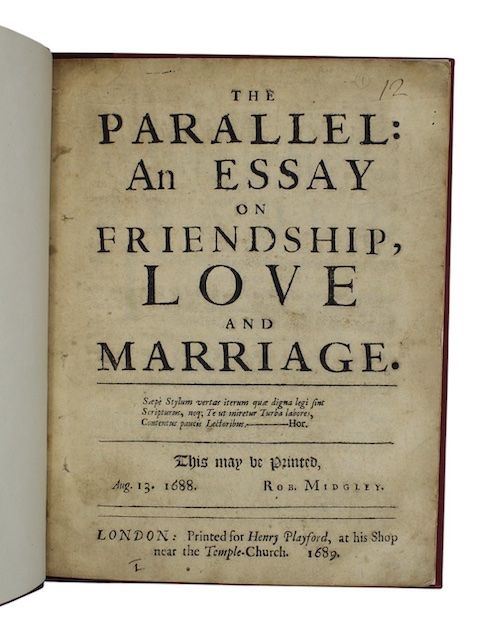
The parallel: An essay on friendship, love and marriage.
London.
Printed for Henry Playford, at his shop near the Temple-Church, 1689.
First edition.
Quarto.
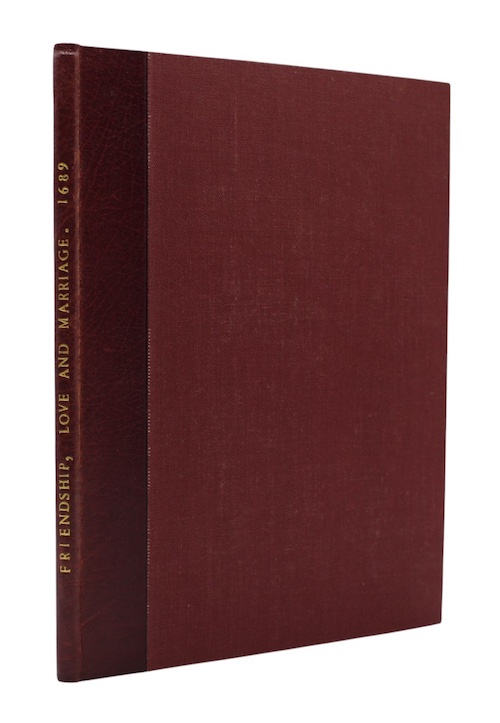
[4], 35pp, [1]. Twentieth- century gilt-tooled red morocco backed cloth boards. With the modern bookplate of Peter Stewart Young to FEP. Some browning, two inked numerals to title, occasional pen trial and a single manuscript correction (shaved) to margins of text.
'In this Essay it is Delightful and Surprizing, to see with what Dexterity the Muse has chang'd Her Pencils, from Panegyrick to Satyr, from Satyr to Pastoral, and the Tenderest Complaints of a Lover, and so Happy in the several Attempts. as if each were her Though the Stanza be difficult, the Expression is easie, the Sense Comprehensive, Just and Strong, and a Climax of Thought reserv'd for every Period.'
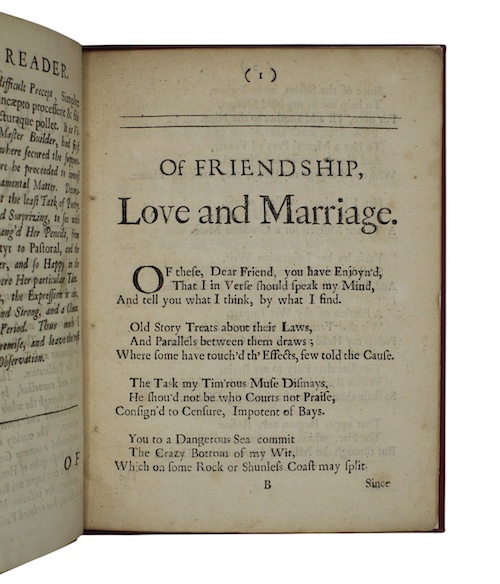
So notes the publisher in his address to the reader in this, the first edition of an anonymous series of verse essays presented, rather unusually, in rhyming triplets. Subjects treated upon - with allusions and direct references to biblical and classical references - include 'Of Liberty', 'Of Flattery', and 'Of Jealousie'.
Frustratingly little is known or has been written of the identity of the author; Hazlitt simply echoes the publisher's own preface, noting that he 'states that this poem was sent to him by a person unknown, with liberty to print or supress it, as he thought fit, but he did not hesitate to send it to print'. The text itself is very short on biographical information. A passage in the essay 'Of Jealousie' suggests, just perhaps that the author emanated from the same country as Shakespeare:
'And Sleepy Avon by whose side,
This Infant Verse its Feet first Try'd,
Wax to a Rapid Stream to Swell the Tide.
By far the largest essay, filling 60 full stanzas, is 'Of love', which treats of the subject in the manner of a hopeless, failing and often flailing romantic:
So by Loves Frailty Undeceiv'd
I, who my Doom to Death have Griev'd
Shou'd scarce feel Comfort now, to be Repriv'd
Hardn'd, by Suffring Ills, we gor,
And forfeit Reverence which we owe;
Thus gentlest Streams, too streightly Pent, O'erflow'
The infidelity of women is highlighted, in tones that make this cataloguer conjure a narrator in the shape of a misogynistic, dissatisfied husband, elsewhere, in the short ten verse treatment 'Of Marriage':
'Scarce the First Man was well awake,
When Eve the Bonds of Wedlock brake,
And Adam had a Rival in the Snake
...
'Well did the Law with Sanctions Bind
The Wedded Pair, which Wife Mankind
Wou'd but for Superstitious Fear Unbind'.
Uncommon: ESTC locates copies at just seven institutions in the British Isles (BL, Cambridge - Trinity College, Leeds, Oxford, Oxford - Magdalen College,= and TCD), and ten further elsewhere (Chicago, Folger, Huntington, LOC, Newberry, Pennsylvania, Princeton, Texas, UCLA and Yale).
So notes the publisher in his address to the reader in this, the first edition of an anonymous series of verse essays presented, rather unusually, in rhyming triplets. Subjects treated upon - with allusions and direct references to biblical and classical references - include 'Of Liberty', 'Of Flattery', and 'Of Jealousie'.
Frustratingly little is known or has been written of the identity of the author; Hazlitt simply echoes the publisher's own preface, noting that he 'states that this poem was sent to him by a person unknown, with liberty to print or supress it, as he thought fit, but he did not hesitate to send it to print'. The text itself is very short on biographical information. A passage in the essay 'Of Jealousie' suggests, just perhaps that the author emanated from the same country as Shakespeare:
'And Sleepy Avon by whose side,
This Infant Verse its Feet first Try'd,
Wax to a Rapid Stream to Swell the Tide.
By far the largest essay, filling 60 full stanzas, is 'Of love', which treats of the subject in the manner of a hopeless, failing and often flailing romantic:
So by Loves Frailty Undeceiv'd
I, who my Doom to Death have Griev'd
Shou'd scarce feel Comfort now, to be Repriv'd
Hardn'd, by Suffring Ills, we gor,
And forfeit Reverence which we owe;
Thus gentlest Streams, too streightly Pent, O'erflow'
The infidelity of women is highlighted, in tones that make this cataloguer conjure a narrator in the shape of a misogynistic, dissatisfied husband, elsewhere, in the short ten verse treatment 'Of Marriage':
'Scarce the First Man was well awake,
When Eve the Bonds of Wedlock brake,
And Adam had a Rival in the Snake
...
'Well did the Law with Sanctions Bind
The Wedded Pair, which Wife Mankind
Wou'd but for Superstitious Fear Unbind'.
Uncommon: ESTC locates copies at just seven institutions in the British Isles (BL, Cambridge - Trinity College, Leeds, Oxford, Oxford - Magdalen College,= and TCD), and ten further elsewhere (Chicago, Folger, Huntington, LOC, Newberry, Pennsylvania, Princeton, Texas, UCLA and Yale).
ESTC R21674. Wing P333.
£ 1,250.00
Antiquates Ref: 25653