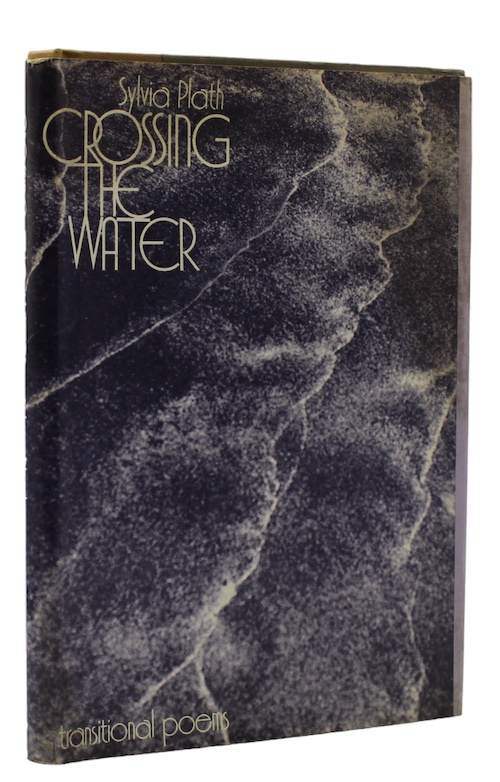
Crossing the water.
New York.
Harper & Row, Publishers, 1971.
First US edition.
8vo.
56pp. Original publisher's quarter bound tan cloth over blue paper, with the decorative gloss dustwrapper. Mauve endpapers, fore and bottom edge untrimmed. Minor scuffs to wrapper, a little smoke damage to both wrapper and board tops. Internally bright and clean.
From the estate of Olwyn Hughes, recently dispersed, without indication of such; the smoke damage is the result of an errant cigarette dropped by Olwyn down the back of her settee, which caused a serious fire.
From the estate of Olwyn Hughes, recently dispersed, without indication of such; the smoke damage is the result of an errant cigarette dropped by Olwyn down the back of her settee, which caused a serious fire.
First US edition of this posthumous poetry collection of the work of Sylvia Plath (1932-1963), arranged for publication by her estranged husband Ted Hughes (1930-1998).
Olwyn Hughes (1928-2016) was a translator, agent and literary executor who had worked in Paris for NATO, Martonplay, and King Peter II of Yugoslavia, among others. After the death of her sister-in-law Sylvia Plath, she returned to England to assist her brother, Ted Hughes, raise his young children, though also took over the management of both his career and Plath's literary estate. While she did have some other clients as a literary agent, including Jean Rhys, much of the rest of her life was dedicated to preserving - and defending - both Plath and Hughes.
£ 75.00
Antiquates Ref: 29567
Olwyn Hughes (1928-2016) was a translator, agent and literary executor who had worked in Paris for NATO, Martonplay, and King Peter II of Yugoslavia, among others. After the death of her sister-in-law Sylvia Plath, she returned to England to assist her brother, Ted Hughes, raise his young children, though also took over the management of both his career and Plath's literary estate. While she did have some other clients as a literary agent, including Jean Rhys, much of the rest of her life was dedicated to preserving - and defending - both Plath and Hughes.