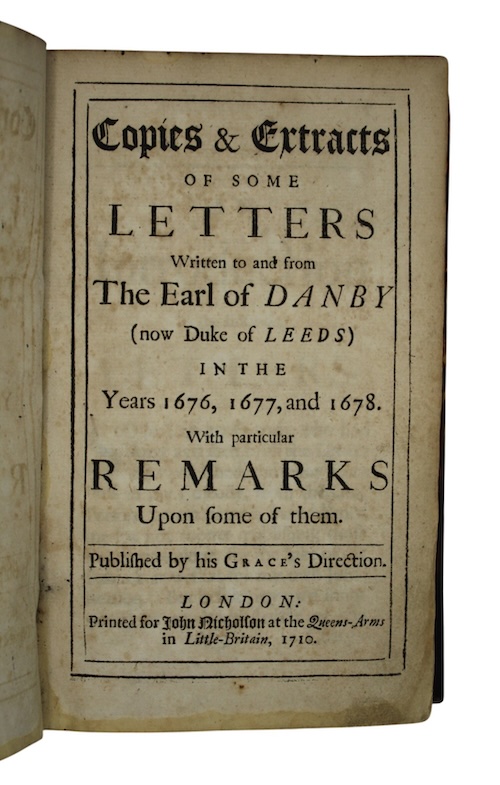
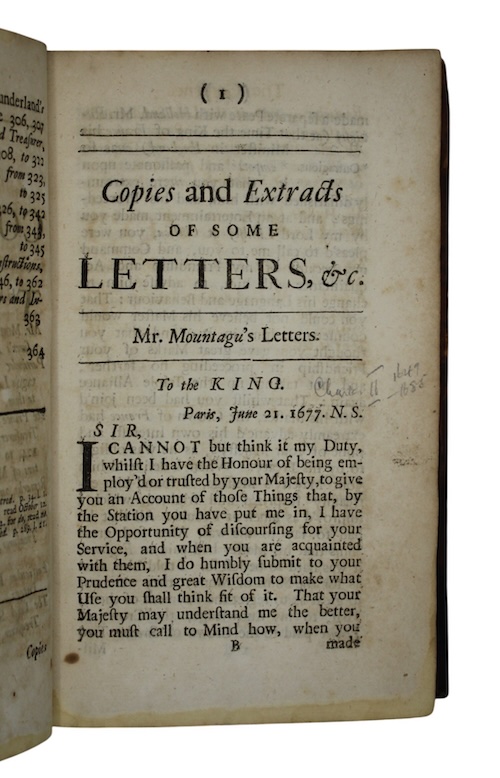
Copies & Extracts of some letters Written to and from The Earl of Danby (now Duke of Leeds) in the Years 1676, 1677, and 1678. With particular remarks Upon some of them. Published by his Grace's Direction..
London.
Printed for John Nicholson , 1710.
First edition.
8vo.
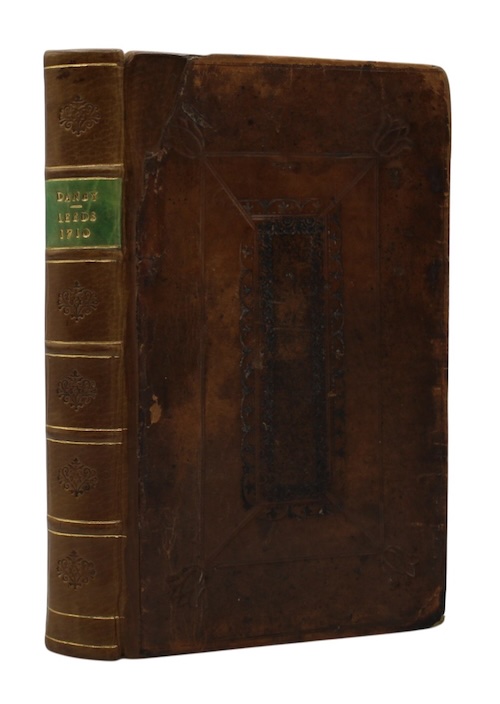
xiii, [3], 364pp, [4]. With two terminal leaves of publisher's advertisements. Contemporary blind-stamped panelled speckled calf, recently rebacked, spine tooled in gilt and blind, with contrasting green morocco lettering-piece. Worn, with staining and singeing to boards. Leaves browned and stained; some light chipping to edges of initial blank fly-leaves.
The first edition of a collection of correspondence to and from Thomas Osborne (1631-1712), published by Osborne himself with intent to disprove the steadily spiralling allegations of French allegiance levied at him in parliament during his fall from grace.
Thomas Osborne (1631-1712), Treasurer to Charles II, then Lord Danby, and later Duke of Leeds. Osborne, who led the government from 1674 until 1678, was impeached under allegations of political obfuscation, supported by the presentation of several secret pro-French treaties leaked by Louis XIV himself. He was voted guilty by the Commons, although the Lords were still in debate when Parliament was dissolved; Osborne, forced to resign in the new Parliament, was later pardoned by the King. During the Glorious Revolution, he was instrumental in the capture of York and Hull by William's forces; he returned to politics as Lord President of the Council under the new government.
Thomas Osborne (1631-1712), Treasurer to Charles II, then Lord Danby, and later Duke of Leeds. Osborne, who led the government from 1674 until 1678, was impeached under allegations of political obfuscation, supported by the presentation of several secret pro-French treaties leaked by Louis XIV himself. He was voted guilty by the Commons, although the Lords were still in debate when Parliament was dissolved; Osborne, forced to resign in the new Parliament, was later pardoned by the King. During the Glorious Revolution, he was instrumental in the capture of York and Hull by William's forces; he returned to politics as Lord President of the Council under the new government.
ESTC T132736.
£ 150.00
Antiquates Ref: 35140