WITH TYPEWRITTEN LETTER TO HENRY WILLIAMSON FROM THE AUTHOR
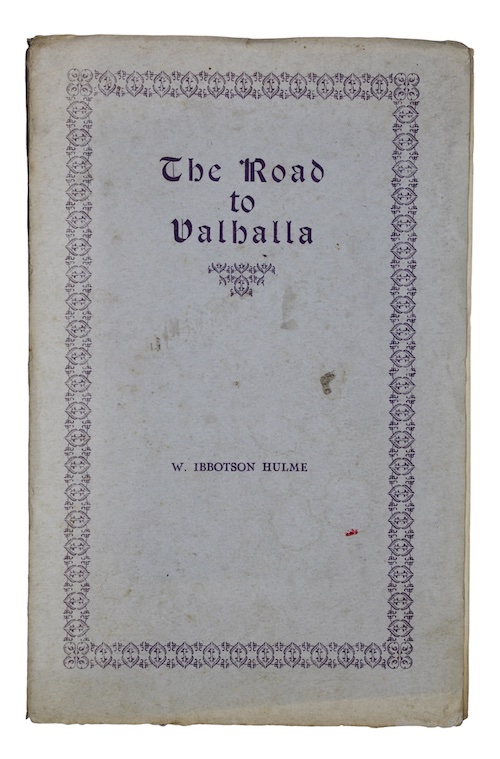
Road to valhalla.
[London?].
[1918].
Private press.
8vo.
64pp. Original publisher's pale printed card wraps over untrimmed handmade paper. Wraps detached from text-block, sunned and marked, with the rear heavily notated in Henry Williamson's hand. Page block internally bright and clean save annotations and corrections again in Williamson's hand. With a T.L.S. from the author to Williamson.
Privately printed for circulation amongst his friends, Hulme's Road to Valhalla is a lavishly clumsy attempt at joining the ranks of distinguished first world war literature. Virtually unheard of, it was finally published for wider consumption by Fleur De Lys publishers in 2011, to little fanfare.
Hulme's loosely inserted letter effusively praises Williamson's The Patriot's Progress, and implores him to read his own account on the basis he thinks they may have had parallel war experiences, fighting in the same location. Williamson's annotations however, in red ink, appear to disagree with both the accuracy of some events, and the author's prose style.
Henry Williamson (1895-1977), novelist and writer on natural history and the English countryside, is predominantly remembered as the author of Tarka the Otter (1927) for which he won the Hawthornden Prize. His wartime experiences on the Western Front having altered his life inexorably, he spent the remainder of his post-war life in Devon, Norfolk and Suffolk, writing naturalistic novels very much in the romantic tradition.
£ 375.00
Antiquates Ref: 27175
Hulme's loosely inserted letter effusively praises Williamson's The Patriot's Progress, and implores him to read his own account on the basis he thinks they may have had parallel war experiences, fighting in the same location. Williamson's annotations however, in red ink, appear to disagree with both the accuracy of some events, and the author's prose style.
Henry Williamson (1895-1977), novelist and writer on natural history and the English countryside, is predominantly remembered as the author of Tarka the Otter (1927) for which he won the Hawthornden Prize. His wartime experiences on the Western Front having altered his life inexorably, he spent the remainder of his post-war life in Devon, Norfolk and Suffolk, writing naturalistic novels very much in the romantic tradition.