GUILD OF WOMEN-BINDERS
[Arts and crafts movement binding].
[s.i.].
[s.n.], [1913].
Quarto.
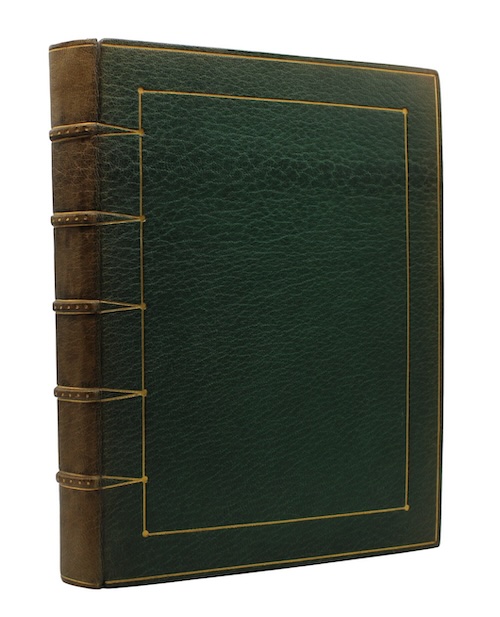
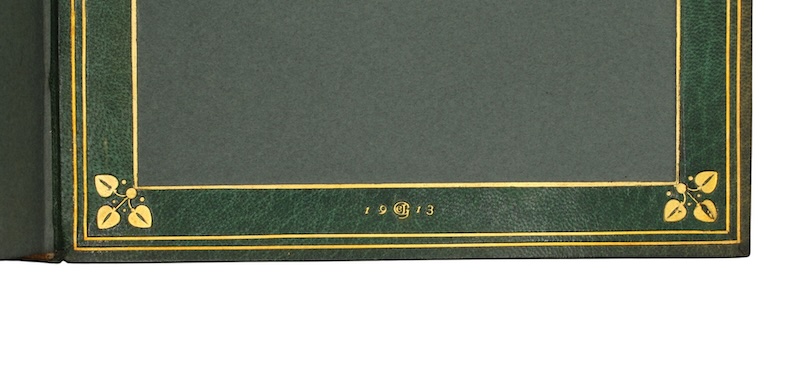
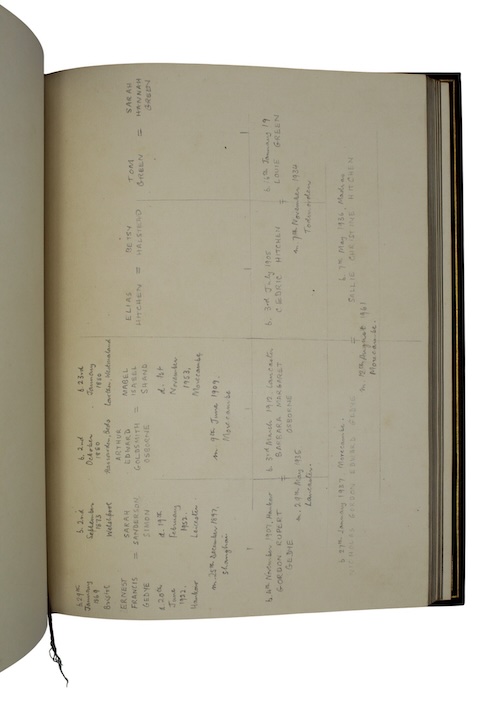
[141] leaves. [12] page of pencilled notes concerning Gedye family genealogy, the remainder blank. Handsomely bound by Edith J. Gedye (stamp-signed '19 EJG 13' to rear turn-in) in green morocco, stylised gilt ruling, A.E.G., gilt ruled turn-ins with gilt foliate corners, green card endpapers. A trifle rubbed, spine dulled.
An attractive Arts and Crafts style binding, well-executed by Edith J. Gedye, a member of the Guild of Women-Binders.
Gedye frequently collaborated with Miss. M. Marshall, a former apprentice of either Douglas Cockerell or Sangorski and Sutcliffe. Together they exhibited jointly signed examples of their work at the Arts and Crafts Exhibition Society functions in 1903 and 1906. Gedye later established a workshop in Bristol, excepting commissions for all manner of bindings, paper and vellum restoration, and calligraphy. The present example of her work was evidently executed for personal use.
The Guild of Women-Binders was established by bookseller and antiquary Frank Karslake (1864-1917) in 1898 to promote the work of female artisans. In addition to selling the work of established binders, such as Florence de Rheims, the society provided training opportunities. The Guild - which Tidcombe highlights was nothing of the sort, but merely a business opportunity operating for Karlake's profit - ceased activities in 1904.
Gedye frequently collaborated with Miss. M. Marshall, a former apprentice of either Douglas Cockerell or Sangorski and Sutcliffe. Together they exhibited jointly signed examples of their work at the Arts and Crafts Exhibition Society functions in 1903 and 1906. Gedye later established a workshop in Bristol, excepting commissions for all manner of bindings, paper and vellum restoration, and calligraphy. The present example of her work was evidently executed for personal use.
The Guild of Women-Binders was established by bookseller and antiquary Frank Karslake (1864-1917) in 1898 to promote the work of female artisans. In addition to selling the work of established binders, such as Florence de Rheims, the society provided training opportunities. The Guild - which Tidcombe highlights was nothing of the sort, but merely a business opportunity operating for Karlake's profit - ceased activities in 1904.
Tidcombe, Womne Bookbinders 1880-1920, p.171-72.
£ 1,250.00
Antiquates Ref: 31489