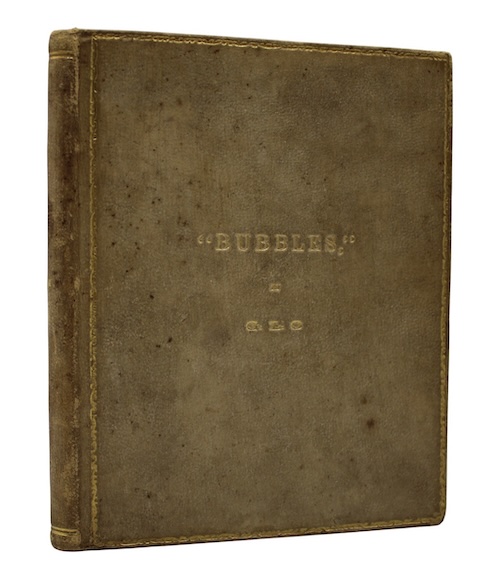
"Bubbles".
[Newcastle-on-Tyne].
[J.W. Swanston, Army Printer], [1886].
First edition.
8vo.
xlvii, [1]. Contemporary gilt-tooled tan-sheep, lettered in gilt to upper board. Lightly rubbed and marked, with spotting and staining to boards. Very occasional light spotting.
A likely dedication copy, unrecorded in the usual databases, of the apparent sole edition, printed and published by J. W. Swanston of St. Andrews' Street, Newcastle, of a collection of poetry written by one only identified as 'G.L.O'. The dedication, simply reading 'to my mother', is supported by this copy's contemporary inscription: 'To My dearest Mother from her most loving son Leslie'.
The poems within illuminate a little more about the anonymous author's life. 'To My Brother' reveals said relative's initials to be J.R.O; 'In Memoriam', dedicated to Lieutenant H.G.L. Howard-Vyse of the mounted infantry, suggests a close connection between the author and the young military martyr. An additional poem dedicated to Surgeon Major P. T. Frazer reinforces the writer's potential military connections. Most entertainingly, the volume's concluding poem, 'Man is So Foolish and Woman is Wise', is an interesting take on the stereotypical courtship dynamics of men and women; whilst acknowledging the trope of the cold-hearted woman and her lovestruck suitor, the second stanza reminds the reader of the equally callous man - 'Has a man ne'er been known with a woman to play?'
£ 375.00
Antiquates Ref: 33805
The poems within illuminate a little more about the anonymous author's life. 'To My Brother' reveals said relative's initials to be J.R.O; 'In Memoriam', dedicated to Lieutenant H.G.L. Howard-Vyse of the mounted infantry, suggests a close connection between the author and the young military martyr. An additional poem dedicated to Surgeon Major P. T. Frazer reinforces the writer's potential military connections. Most entertainingly, the volume's concluding poem, 'Man is So Foolish and Woman is Wise', is an interesting take on the stereotypical courtship dynamics of men and women; whilst acknowledging the trope of the cold-hearted woman and her lovestruck suitor, the second stanza reminds the reader of the equally callous man - 'Has a man ne'er been known with a woman to play?'